
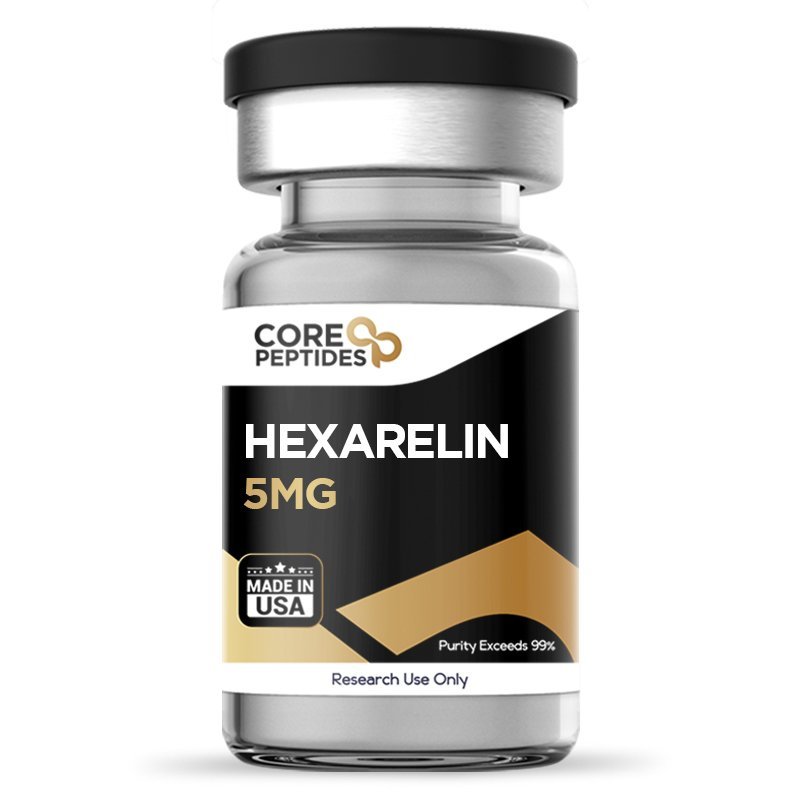
Hexarelin (5mg) Research Peptide | Core Peptide USA
Hexarelin (5mg) is a synthetic growth hormone–releasing peptide (GHRP) widely studied for its ability to stimulate growth hormone (GH) secretion through ghrelin receptor activation. At Core Peptide, we supply high-purity Hexarelin (5mg) strictly for research and laboratory use to qualified professionals across the United States.
Hexarelin, also known as Examorelin, is structurally distinct yet functionally similar to other GHRPs such as GHRP-6. Since its development over two decades ago, Hexarelin has remained an important compound in endocrine, metabolic, cardiovascular, and muscle tissue research.
👉 View our full catalog of research peptides:
Internal Link: https://corepeptide.us/peptides
What Is Hexarelin?
Hexarelin is a synthetic hexapeptide composed of six amino acids. It is classified as a growth hormone secretagogue (GHS) due to its ability to stimulate GH release via growth hormone secretagogue receptors (GHS-Rs), particularly GHSR-1a.
Unlike native growth hormone–releasing hormone (GHRH), which acts primarily at the hypothalamic level, Hexarelin is believed to act directly on pituitary cells and indirectly through hypothalamic pathways. This dual mechanism has made Hexarelin (5mg) a valuable tool in growth hormone regulation research.
Chemical Profile of Hexarelin (5mg)
-
Molecular Formula: C₄₇H₅₈N₁₂O₆
-
Molecular Weight: 887.05 g/mol
-
Peptide Class: Growth Hormone–Releasing Peptide (GHRP)
-
Other Names: Examorelin
Core Peptide provides Hexarelin (5mg) in sealed vials intended for controlled laboratory protocols.
Mechanism of Action
Hexarelin is hypothesized to function by mimicking ghrelin, a naturally occurring 28-amino-acid peptide involved in GH secretion and appetite regulation. By binding to GHSR-1a receptors located in the pituitary gland, hypothalamus, and other tissues, Hexarelin may stimulate GH release through G-protein–dependent signaling pathways.
Research suggests receptor activation may trigger intracellular cascades involving protein kinase C (PKC) and other signaling mediators, ultimately promoting GH secretion from anterior pituitary cells. However, prolonged exposure may lead to temporary receptor desensitization, an effect that has been observed with other GHRPs as well.
Hexarelin (5mg) and Growth Hormone Research
Multiple studies have investigated Hexarelin’s potential to stimulate GH release across various age groups. Research indicates that Hexarelin may induce robust GH secretion in adolescent and mature models, often exceeding GH levels stimulated by GHRH alone.
In elderly research models, Hexarelin has been shown to increase GH levels compared to baseline and GHRH exposure, although responses may be less pronounced than combined GHRH-arginine protocols. These findings support continued interest in Hexarelin (5mg) for age-related endocrine research.
Potential Synergy With GHRH
One notable area of study involves Hexarelin and GHRH synergism. Research using GH-secreting tumor cell lines suggests that Hexarelin and GHRH may act on distinct receptor pathways, allowing for additive or complementary GH stimulation.
In GH1 murine tumor cell models that were insensitive to GHRH alone, Hexarelin demonstrated the ability to stimulate GH secretion independently. When both compounds were present, researchers observed additive effects, reinforcing the hypothesis that GHRPs and GHRHs regulate GH synthesis via separate mechanisms.
Cardiovascular Research Applications
Hexarelin has also been studied for its cardiovascular activity. Experimental data suggest that acute Hexarelin exposure may produce positive inotropic effects, including increased left ventricular ejection fraction (LVEF) without significantly altering blood pressure.
In ischemic and myocardial infarction models, Hexarelin has been associated with:
-
Improved cardiac output
-
Increased stroke volume
-
Reduced peripheral resistance
-
Inhibition of cardiomyocyte apoptosis
These findings have positioned Hexarelin (5mg) as a compound of interest in cardiovascular and myocardial protection research.
Body Composition and Metabolic Research
Research investigating Hexarelin’s effect on body composition suggests a negative correlation between fat mass and GH response. Models with higher adiposity exhibited reduced GH release following Hexarelin exposure, while lean mass appeared to respond more robustly.
Interestingly, studies report no significant gender-based differences in GH response, making Hexarelin a consistent research tool across sex-based metabolic investigations.
Muscle Tissue and Catabolic Research
Preliminary studies indicate that Hexarelin may have muscle-sparing properties under catabolic conditions. In experimental models exposed to catabolic stressors, Hexarelin administration was associated with:
-
Reduced muscle mass loss
-
Attenuation of strength decline
In one study, muscle loss decreased from approximately 12% to 7% when Hexarelin was introduced, suggesting a potential protective effect on skeletal muscle tissue. These findings support ongoing research into Hexarelin (5mg) for muscle preservation studies.
Appetite and Neuroendocrine Research
Because GHSR-1a receptors are expressed in multiple regions of the nervous system, Hexarelin may influence appetite-regulating neuropeptides such as Neuropeptide Y (NPY) and Agouti-related peptide (AgRP). Concurrent reductions in α-melanocyte-stimulating hormone (α-MSH) have been hypothesized, potentially shifting signaling toward increased hunger.
Additionally, Hexarelin may interact with the mesolimbic reward system, an area involved in motivation and feeding behavior, further expanding its relevance in neuroendocrine research.
Why Buy Hexarelin (5mg) From Core Peptide?
Researchers across the United States choose Core Peptide for:
-
🇺🇸 U.S.-based distribution and fast domestic shipping
-
🧪 High-purity, research-grade peptides
-
📄 Transparent quality standards
-
🔒 Secure packaging and batch consistency
👉 Review our policies before ordering:
Internal Link: https://corepeptide.us/terms-and-conditions
References & External Resources
-
Giustina A et al. Regulatory Peptides – Hexarelin and GH secretion
External Link: https://pubmed.ncbi.nlm.nih.gov/9250581/ -
National Center for Biotechnology Information – Examorelin (Hexarelin)
External Link: https://pubchem.ncbi.nlm.nih.gov/compound/Examorelin
Be the first to review “Hexarelin (5mg)”
Related products
Peptides
Peptides
Peptides
Peptides
Reviews
There are no reviews yet.