
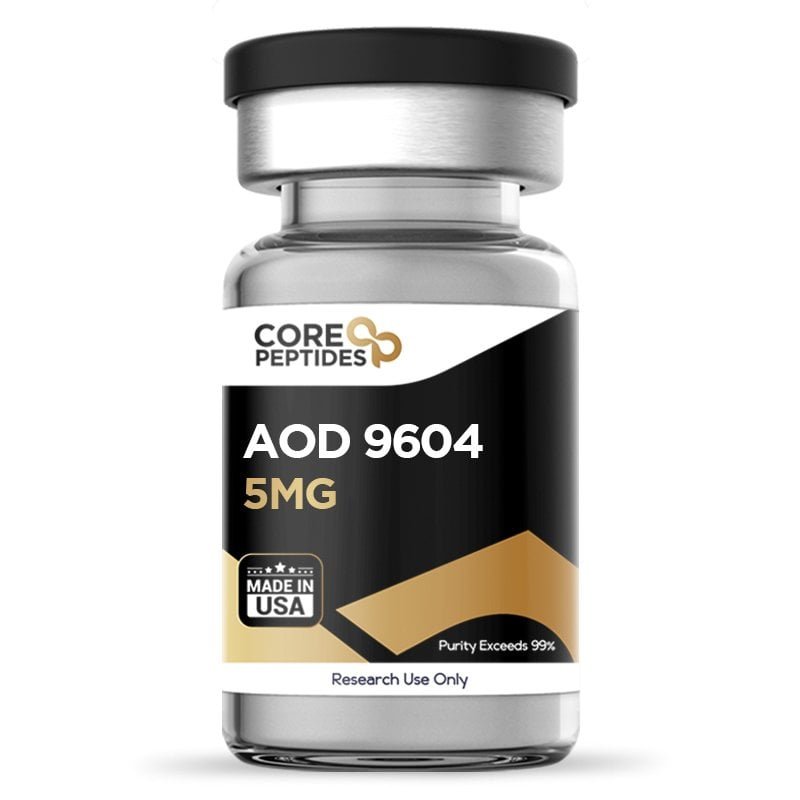
AOD 9604 (5mg) – Research Peptide for Fat Metabolism and Weight Loss Studies
At Core Peptide US, we provide AOD 9604 (5mg), a research-grade peptide widely studied for its potential in fat metabolism, weight regulation, and obesity research. Also known as GH Fragment 176-191 or Tyr-hGH Fragment 177-191, this peptide is a modified fragment of human growth hormone (hGH) specifically designed to mimic the lipolytic effects of growth hormone without stimulating Insulin-like Growth Factor 1 (IGF-1).
What is AOD 9604 (5mg)?
AOD 9604 is a synthetic peptide derived from the last 16 amino acids of hGH. This fragment includes a tyrosine residue at the N-terminus, which increases peptide stability for laboratory use. Researchers consider AOD 9604 the lipolytic portion of hGH, meaning it may stimulate the breakdown of stored fat without inducing the broader effects of full-length growth hormone.
This peptide has been primarily studied for its potential anti-obesity properties, and its effects appear to focus on enhancing fat breakdown (lipolysis), increasing energy expenditure, and improving fat oxidation in experimental models (external reference: PubMed).
Chemical Makeup of AOD 9604 (5mg)
-
Molecular Formula: C78H123N23O23S2
-
Molecular Weight: 1815.12 g/mol
-
Other Names: Tyr-hGH Fragment 177-191, GH Fragment 176-191
Mechanism of Action
AOD 9604 primarily influences lipolytic receptors in fat cells, particularly the beta-3 adrenergic receptor (beta-3-AR). These receptors are critical for initiating fat breakdown. Studies suggest that AOD 9604 may enhance the sensitivity of these receptors, making fat cells more responsive to lipolytic signals.
In addition, AOD 9604 may increase energy expenditure and fat oxidation, which are considered vital in its potential fat-reducing effects. Importantly, research indicates that it may not rely solely on beta-3-AR, but also triggers other pathways to promote lipid metabolism, making it a versatile peptide for laboratory research (external reference: NCBI).
Research and Clinical Studies on AOD 9604 (5mg)
Lipolytic Activity in Animal Models
Early studies in obese mice demonstrated that AOD 9604 administration reduced fat and weight gain after 14 days of treatment. The results were associated with increased expression of beta-3 adrenergic receptors in fat cells. These studies suggested that the peptide could mimic some effects of natural hGH without inducing full hormonal activity.
Further studies in obese Zucker rats reported over 50% reduction in weight gain in rats treated daily for 19 days, compared to placebo. The treated animals also exhibited enhanced fat oxidation and no adverse effects on insulin sensitivity (source).
Clinical Studies in Humans
In 2004, clinical trials involved 300 obese participants receiving AOD 9604 over a 12-week period. The study observed:
-
Consistent weight loss throughout the trial
-
Slight improvements in cholesterol profiles
-
Minor enhancements in glucose tolerance
These results suggest that AOD 9604 (5mg) may offer a research tool for studying anti-obesity mechanisms and metabolic regulation without the risks associated with full-length growth hormone administration (external reference: PubMed).
Potential Mechanisms in Fat Loss
-
Enhanced Lipolysis: AOD 9604 may stimulate the breakdown of triglycerides into glycerol and free fatty acids.
-
Beta-3 Adrenergic Receptor Sensitization: May improve receptor responsiveness in adipocytes, promoting fat breakdown.
-
Increased Energy Expenditure: Supports the body’s fat oxidation and metabolic activity.
-
No IGF-1 Stimulation: Unlike full-length hGH, AOD 9604 does not appear to increase IGF-1, reducing potential side effects.
These mechanisms make AOD 9604 (5mg) an ideal peptide for researchers studying obesity, lipid metabolism, and metabolic regulation.
Why Choose Core Peptide US for AOD 9604 (5mg)
At Core Peptide US, we provide high-quality, lab-grade AOD 9604 (5mg) suitable for U.S.-based research. Our advantages include:
-
Verified purity and quality control
-
Fast domestic shipping across the United States
-
Comprehensive product documentation for laboratory use
-
Wide selection of peptides for metabolic and growth research, including GHK-Cu peptide and AICAR (50mg)
Applications of AOD 9604 (5mg) in Research
-
Obesity Research: Studying fat metabolism and lipolysis in cellular and animal models.
-
Metabolic Regulation: Investigating energy expenditure, glucose metabolism, and fat oxidation.
-
Beta-3 Adrenergic Receptor Studies: Examining receptor signaling and fat cell responsiveness.
-
Safety Studies: Researching peptides that mimic hGH effects without IGF-1 stimulation.
AOD 9604 (5mg) is strictly for research and laboratory purposes. Please review our Terms and Conditions before ordering.
Ordering AOD 9604 (5mg) in the United States
AOD 9604 (5mg) is intended exclusively for laboratory research, including metabolic, obesity, and lipolytic studies. By sourcing from Core Peptide US, U.S.-based researchers can access:
-
Consistently high-purity peptides
-
Fast shipping across the United States
-
Verified laboratory documentation for study compliance
For other research peptides, check our internal links to GHK-Cu and AICAR (50mg) for complementary metabolic research.
References & Further Reading
-
Methods and experimental research on GH Fragment 176-191 (PubMed)
-
Lipolytic activity studies in obese animal models (ScienceDirect)
-
Clinical trials on AOD 9604 in obese subjects (PubMed)
AOD 9604 (5mg) is a highly studied research peptide with potential in fat metabolism, energy regulation, and anti-obesity research. Its focus on lipolysis and beta-3 adrenergic receptor sensitization, along with its lack of IGF-1 stimulation, makes it a valuable tool for laboratory investigations into metabolic health and obesity-related studies.
Be the first to review “AOD 9604 (5mg)”
Related products
Peptides for sale
Peptides for sale
Peptides for sale

Peptides for sale
Peptides for sale
Peptides for sale
Peptides for sale
Peptides for sale
Reviews
There are no reviews yet.