
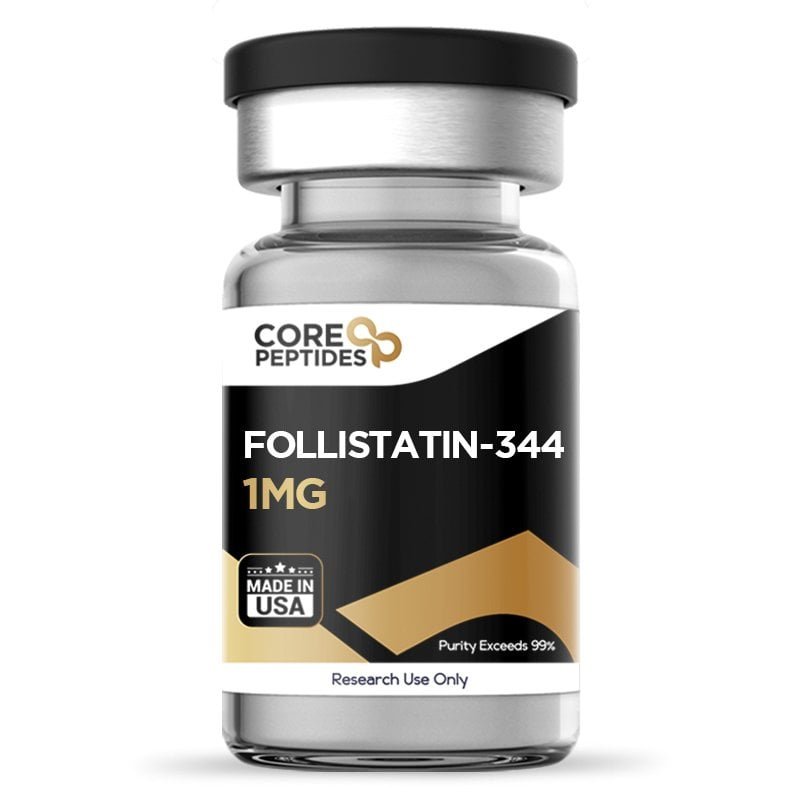
Follistatin-344 (1mg) – Advanced Research Peptide for Muscle and Cellular Studies
Follistatin-344 (1mg) is a synthetic version of a naturally occurring glycoprotein that plays a central role in cell signaling, growth regulation, and protein binding within the TGF-β superfamily. Naturally present in nearly all tissues, follistatin functions as an autocrine signaling protein, meaning it is produced and acts locally within the same cellular environment.
At Core Peptide, we supply Follistatin-344 (1mg) exclusively for research and laboratory use, supporting peptide research programs across the United States with consistent quality and verified purity.
What Is Follistatin-344?
Follistatin exists naturally in two primary isoforms:
-
Follistatin-317 (FST-317)
-
Follistatin-344 (FST-344)
These isoforms arise from alternative mRNA splicing and are named after their precursor molecules. While both forms are biologically relevant, Follistatin-344 is the predominantly expressed isoform in most tissues, accounting for the majority of follistatin mRNA expression.
Follistatin-344 (1mg) is synthesized to mirror the structure and activity of the endogenous protein. At its core, follistatin contains three conserved functional domains (FSD1, FSD2, FSD3), each rich in cysteine residues that enable strong binding interactions with target proteins.
Chemical Profile of Follistatin-344 (1mg)
-
Molecular Weight: ~3780 g/mol
-
Molecular Formula: Not applicable (protein-based)
-
Protein Domains: FSD1, FSD2, FSD3
-
Other Names: Activin-Binding Protein, FSH-Suppressing Protein, FST
Additional molecular data can be reviewed through the National Center for Biotechnology Information (NCBI):
https://www.ncbi.nlm.nih.gov/gene/10468
Biological Role and Mechanisms of Action
The primary biological function of Follistatin-344 (1mg) is its high-affinity binding to activin and related growth factors. By neutralizing these proteins, follistatin regulates multiple physiological pathways.
Activin and FSH Regulation
Activin plays a key role in stimulating follicle-stimulating hormone (FSH) secretion. Follistatin binds to activin, reducing its biological activity and thereby modulating reproductive signaling within the pituitary-gonadal axis.
Interaction with the TGF-β Superfamily
Follistatin-344 is believed to interact with several members of the Transforming Growth Factor-beta (TGF-β) superfamily, including:
-
Activins
-
Bone Morphogenetic Proteins (BMPs)
-
Growth Differentiation Factors (GDFs)
Among these, its interaction with myostatin (GDF-8) has been the most widely studied.
Follistatin-344 (1mg) and Muscle Development Research
Myostatin is a powerful negative regulator of muscle growth. By binding to and inhibiting myostatin, Follistatin-344 (1mg) has become a major focus in muscle hypertrophy and muscle disease research.
In landmark animal studies, mice exposed to increased follistatin expression showed dramatic increases in skeletal muscle mass—sometimes two to three times greater than controls. This increase was attributed to both:
-
Muscle fiber hypertrophy (increased size)
-
Muscle fiber hyperplasia (increased number)
Unlike myostatin-specific inhibitors, Follistatin-344 also antagonizes activin A, a protein associated with muscle catabolism and fibrosis. This dual inhibition may offer broader insights in research models studying muscle degeneration and dystrophy.
For further reading:
https://www.ncbi.nlm.nih.gov/pmc/articles/PMC2717722/
Follistatin-344 and Cellular Proliferation
Research indicates that Follistatin-344 (1mg) may influence cell growth and regeneration, particularly in hepatocytes. Experimental models suggest that inhibiting activin signaling via follistatin may be a prerequisite for cellular proliferation.
This dual role—limiting metastasis in some models while promoting controlled proliferation in others—has made Follistatin-344 a peptide of interest in oncology and regenerative research.
Liver Protection and Fibrosis Studies
In experimental liver fibrosis models, Follistatin-344 exposure was associated with:
-
A 32% reduction in liver fibrosis
-
Up to 90% reduction in hepatocyte apoptosis
These findings suggest Follistatin-344 may modulate signaling pathways involved in tissue repair and cellular survival.
Cancer-Related Research
Breast Cancer Models
Gene expression studies indicate that follistatin may be under-expressed in certain breast cancer cells, potentially allowing activin-driven metastasis. Restoring follistatin expression has been proposed as a method to counteract activin-mediated tumor spread.
Esophageal Cancer Models
Bone morphogenetic proteins (BMPs) are implicated in esophageal carcinogenesis. By modulating BMP signaling, Follistatin-344 may influence early cellular transitions associated with malignancy, particularly in inflammation-driven environments.
Reference:
https://www.ncbi.nlm.nih.gov/pmc/articles/PMC5219916/
Follistatin-344 and Metabolic Research
In diabetic murine models, Follistatin-344 overexpression appeared to:
-
Increase pancreatic β-cell mass
-
Improve glucose regulation
-
Activate insulin-PI3K-Akt signaling pathways
These effects were associated with suppression of SMAD2/3 signaling and increased expression of betatrophin, a hormone linked to β-cell proliferation.
Hair Follicle and Regenerative Studies
Clinical research involving follistatin-based complexes suggests potential stimulation of interfollicular stem cells, resulting in:
-
Increased hair density
-
Improved follicle thickness
While these studies involve complex formulations, they highlight follistatin’s influence on tissue regeneration.
Why Choose Core Peptide for Follistatin-344 (1mg)?
At Core Peptide USA, we are dedicated to supporting advanced peptide research by offering:
-
High-purity Follistatin-344 (1mg)
-
Accurate labeling and controlled packaging
-
Reliable shipping across the United States
-
Strict research-use-only compliance
Explore more resources:
Be the first to review “Follistatin-344 (1mg)”
Related products
Peptides for sale

Peptides for sale

Peptides for sale
Peptides for sale
Peptides for sale
Peptides for sale
Peptides for sale

Peptides for sale
Reviews
There are no reviews yet.